Showing posts with label electronic health record. Show all posts

Wednesday, February 7, 2018

TSI Healthcare Awarded Top Customer Service Accolades By The Stevie® Awards For Fourth Consecutive Year

TSI Healthcare, a national leader in the sales and support of NextGen® Practice Management solutions and Electronic Health Record solutions, added to its industry achievements by being named as a top ranked customer service provider by the 2018 Stevie Awards® for Sales & Customer Service in Healthcare, Pharmaceuticals, and related industries. This year’s accolade marks the fourth consecutive year TSI Healthcare has received this most selective international award.
The Stevie Awards for Sales and Customer Service, in its eleventh year, evaluated more than 2,500 nominations from organizations of all sizes and industries worldwide. The awards seek to identify standout companies in categories that include everything from sales and corporate development to customer support.
“The 2018 judges were so impressed with the wide range of achievements detailed in the Finalist nominations,” said Michael Gallagher, president and founder of the Stevie Awards. “We look forward to announcing the Gold, Silver and Bronze Stevie placements in Las Vegas next month.”
As part of selection process, TSI Healthcare was evaluated by various expert committees on a number of factors such as customer satisfaction, industry accomplishments, and innovative programs. With a commitment to

“concierge-style” support and hand-held federal policy guidance, the company maintained a 99 percent client satisfaction rating. TSI Healthcare remains the only fully integrated EHR/PM vendor to ever earn honors in this category.
“We are again honored for this recognition by the Stevie Awards®. Our fourth year as a top performer in the category of outstanding service is the result of many key factors that distinguish our company in the healthcare IT space,” said David M. Dickson, Jr., TSI Healthcare’s founder, president, and CEO. “Since our inception in 1997, we have remained committed to a customer-centric focus that is wholly unique and clearly advantageous for each of our valued Clients.”
The official rankings (Gold, Silver, or Bronze) will be announced during a gala banquet on Friday, February 23 at Caesars Palace in Las Vegas, Nevada.
About TSI Healthcare

TSI Healthcare is the national leader in the sales and support of customized NextGen® Practice Management and Electronic Health Record solutions. The company’s solutions are designed to meet the unique needs of practices through specialty specific EHR content, top ranked service, and award winning solutions. In addition to core products powered by NextGen®, TSI Healthcare also offers Patient Portal, Population Health Management, Revenue Cycle Management, cloud hosting, and more. TSI Healthcare has approximately 200 employees and has provided services to more than 2,100 providers nationwide since its inception in 1997. For more information, visit http://www.tsihealthcare.com, or call 800-354-4205.
About The Stevie Awards

Stevie Awards are conferred in seven programs: the Asia-Pacific Stevie Awards, the German Stevie Awards, The American Business Awards, The International Business Awards, the Stevie Awards for Great Employers, the Stevie Awards for Women in Business and the Stevie Awards for Sales & Customer Service. Stevie Awards competitions receive more than 10,000 entries each year from organizations in more than 60 nations. Honoring organizations of all types and sizes and the people behind them, the Stevies recognize outstanding performances in the workplace worldwide. Learn more about the Stevie Awards at http://www.StevieAwards.com.

Friday, April 8, 2016

TSI Healthcare Ranks Number 1 Worldwide In Customer Service

TSI Healthcare Ranks Number 1 Worldwide In Customer Service


CHAPEL HILL, NC – April 8, 2016 – TSI Healthcare, a national leader in the sales and support of customized NextGen® Practice Management and Electronic Health Record solutions, added another accolade to its growing list of achievements. TSI Healthcare took home the top Stevie Award in the “Healthcare, Pharmaceuticals, and Related Industries” category at the 2016 Stevie Awards for Sales & Customer Service. This honor follows recent recognition from Black Book for top rankings in “Specialty Content” and Modern Healthcare as one of the “Best Places to Work in Healthcare.”

The Stevie Awards for Sales & Customer Service, informally known as the “Oscars” of Customer Service, are awarded to the world’s top sales, business development, contact center, and customer service teams. More than 2,100 nominations from organizations of all sizes and industries worldwide were evaluated in this year’s competition. Award recipients for other categories included Cisco, Delta, Marriott Vacation Club, and iHeart Media.

“Entries to the Stevie Awards for Sales & Customer Service continue to grow every year, further validating the essential role that customer service plays in business success,” said Michael Gallagher, president and founder of the Stevie Awards. “The judges were deeply impressed by the winner’s accomplishments and we congratulate all of the winners on their commitment to excellence and innovation.”

As part of the selection process, TSI Healthcare was judged on a number of factors, including customer satisfaction, industry accomplishments, and innovative programs. TSI Healthcare earned the top award for its commitment to “concierge-style” support and hand-held approach to healthcare reform. Amidst the far-reaching and ever evolving changes to the healthcare industry, TSI Healthcare exceeded judges’ expectations with their commitment to providing platinum-level customer service to each physician client.

“As healthcare reform continues to become more strenuous to physicians, the service teams behind the products must be exceptional,” said David M. Dickson, Jr. “This award is a testament to the culture of TSI Healthcare. We remain committed to providing each client with a complete customer service experience unmatched by anyone else and we are honored by this repeat recognition from the Stevie Awards.”

About TSI HealthcareTSI Healthcare, founded in 1997, is a national leader in the sales and support of customized NextGen® Practice Management and Electronic Health Record solutions. TSI Healthcare’s solutions are designed to meet the unique needs of specialty practices through specialty specific EHR content, top ranked service, and award winning software. In addition to core products powered by NextGen, TSI Healthcare also offers Patient Portal, Population Health Management, Revenue Cycle Management, cloud hosting, and more. TSI Healthcare’s support and service teams include NextGen Certified Professionals, clinicians, and former practice administrators. For more information, visit www.tsihealthcare.com or call 800-354-4205.

About The Stevie AwardsThe Stevie Awards are conferred in six programs: The American Business Awards, the German Stevie Awards, The International Business Awards, the Stevie Awards for Women in Business, the Stevie Awards for Sales & Customer Service, and the Asia-Pacific Stevie Awards. A seventh program, the Stevie Awards for Great Employers, will debut in April 2016. Honoring organizations of all types and sizes and the people behind them, the Stevies recognize outstanding performances in the workplace worldwide. Learn more about the Stevie Awards at http://www.StevieAwards.com, and follow the Stevie Awards on Twitter @TheStevieAwards.

###


Tuesday, April 1, 2014

REPOST: The Boom Continues: Dissecting HIMSS14

Health information technologies have attracted plenty of healthcare reforms that they are now a staple in every medical institution's digital services, citing the vital role they play in care coordination, patient engagement, and analytics. More insights into the rapidly evolving healthcare industry can be read here:


Image source: ehealthreporter.com

If attendance at the annual Health Information Management Systems Society (HIMSS) conference is a barometer of the state of the health IT industry, then the sector continues to grow at a rapid pace, but is starting to converge. HIMSS 2014 set a new record for attendance, with close to 38,000 participants. If that’s not significant enough, over 1,200 health related IT companies exhibited in the cavernous 50,000 square foot exhibit hall. Even some of the relatively new companies to enter the market claimed large spaces in the exhibition hall, validating the willingness of venture capital and angel investor money to both launch and fund these ventures.

This event is choreographed to display the grandeur of the health information technology revolution driving healthcare reform in America and the massive formation of the digital tools responsible for transforming the healthcare industry, all under one big top. While it could be argued that this year’s HIMSS event lacked a new dominant theme, and that the message across nearly every booth was population health management and analytics, it was clear that despite political haggling and partisan politics, health IT continues to be one of the clear winners in the transformation of healthcare.

If you think of the main exhibit hall as an ecosystem, at the apex of the food chain stood the dominant EHR providers: Epic, Cerner, Allscripts and McKesson. Emerging quickly in numbers to challenge this hierarchy are the many and adaptable population health management (PHM) companies. Deep in the peripheral tributaries of the exhibit hall were emerging raptors, small in stature this year, but positioned to evolve quickly (or die), including healthcare analytics companies, optimization consultants and care coordination platforms. The idea-to-market timeline continues to shrink for new and innovative solutions – a far cry from the decades of application theory and beta testing for electronic health records. We see this all too critical acceleration in product development as a very strong driver for continued health IT business initiatives and company launches, as well as future 3rd party investments.

What sense can we make from the maze of exhibitors, EHR vendors, PHM technology companies, health IT start-ups, clinical management technologies, and volume-driven to value-based conversion entities? Now more than ever before, there are unique and compelling opportunities for health IT business development for the immediate and long term time frames. Growth in the opportunities to apply technology and to change the business of care delivery exist, with plenty of room for expansion, which will come as the healthcare industry pivots and explores new approaches to provide comprehensive care to defined populations.

Additionally, we see a coming “applification” of healthcare; a dawning of an insatiable need for functionality, with more companies bringing forth application development programs for care coordination, patient engagement and analytics. There is a natural adaptation that will seize upon this need and work tirelessly to find that “sweet spot” for providers and payers to digitally link to patients, thus creating an umbilicus for shared health information that flows in near real-time, bi-directionally and is secure. This is on the horizon, and we can expect steps toward this reality in the very near future.

The collective message, strategy or axiom to learn from HIMSS14 is one of appreciation for the forces at work to bring about change. Make no mistake, there are many and they are of significant power to push the industry forward, rapidly. Government agencies such as CMS and the Office of the National Coordinator (ONC) are scrambling to stimulate, harness, guide and govern this phenomenon.

The question post-HIMSS14 is: In a world of declining growth in revenues from traditional RVU-based sources, how will organizations continue to pay for these needed IT support solutions that are becoming required elements of survival for healthcare providers? Early adopters of the ACO model are already seeing that the level of investment required to create the infrastructure needed to support the care collaboration is higher than expected and ongoing. Meanwhile, targets will likely become harder to hit, revenues will become more and more restrained, and simple gains in efficiencies could become harder to find.

TSI Healthcare is a leading provider of top-notch technology solutions for its partners in the healthcare industry. Visit this website to know more about its services.

Tuesday, March 25, 2014

Revealed: The Secrets to a Great Revenue Cycle Strategy, Part 1


As in all businesses, there are many challenges to effectively delivering services; Revenue Cycle Management services are no different.  Revenue Cycle Management (RCM) includes everything from verifying patient eligibility and up-front payment collection to coding, claims processing and tracking, and payment posting. There are no secrets to revenue cycle strategy, only basic principles that, when properly followed either by your billing staff or your RCM services provider, will enable you to get better medical revenue cycle results.  This will be the first in a multi-part series which will examine these principles. 

  1. Collect Patient Balances the Same Day of Service. 
     
    All specialties are unique, and each requires its own tailoring, yet the fact remains that the best receivables strategy is not to have any.  Colleting co-pays, patient balances, upfront payment plans, etc., at the time of service (or at least as much as possible), minimizes what many practices have difficulty collecting afterward.  Collect up front.  Most businesses do.
     
  2. Verify Patient Insurance Eligibility.
     
    Even some of the most advanced practices are not using this function.  Because we are a provider of services based on collections, much of which comes from insurance companies, it is important for us that we have our clients verify patient eligibility whenever possible. This can be done either before their scheduled visit or at check-in.  Follow up efforts (and costly staff resources) greatly increase when a patient’s insurance eligibility is not verified at the time of service.  
     
  3. Implement a Triple Clean Claims Scrubbing
     
    Just like quality control on a factory assembly line, it is more productive to build your claims properly the first time.  The most effective claims scrubbing involves multiple review processes, often as follows:

  1. The first scrub is performed manually by charge entry staff with comprehensive coding knowledge. The team looks at the claim to make sure proper codes are being used, the proper procedures have been ordered, and that the proper modifiers have been included, if necessary. This should be done prior to electronically submitting claims to the clearinghouse.
  2. The second scrub is performed by your Enterprise Practice Management (EPM) software.  The strongest EPM software solutions can check your claims against the similar practices in the healthcare community for potential errors before the claims are electronically submitted to the clearinghouse.  As more and more edits are accumulated, clean claim rates should continue to improve.  Any errors from this scrub should then be manually reviewed.
  3. The third scrub is performed at the clearinghouse level where claims can be cleaned up post-submission but before reaching their final destination with the payer. As with the second scrub, any errors should be manually reviewed.
     
    Implementation of these revenue cycle management principles should be followed up by inspection to ensure that they are being done properly.  The investment in time taken to make sure these processes are properly in place are well worth it.
     
    Check back soon when we pick this back up with a look at proper claims denial management processes.  
David Dyer
Vice President of

Monday, February 17, 2014

TSI Healthcare Employee Spotlight: David Dyer

TSI Healthcare Employee Spotlight on David Dyer


Meet David!
David is our Vice President of Revenue Cycle Services Group and Business Development. He joined the TSI Healthcare Family in October 2013. David can always be counted on for a kind word, a helping hand, or if you are lucky, a soulful tune. Get to know David a little better…
 

What are you most proud of?
“My two daughters”
 
What is your favorite hobby?
“Creating and performing music”
 
What is your personal mantra?
“Think positive, treat people like you would like to be treated, and fix things at the source.”
 
Why do you love TSI Healthcare?
“We are all family, we all evolved from the same source, and we provide a valuable service.”
 
What is the most random item on your desk?
“Steak Sauce”
 
To read more about TSI Healthcare's Revenue Cycle Management Services offerings, visit us at http://www.tsihealthcare.com/our-solutions/revenue-cycle-management/.

Monday, February 3, 2014

REPOST: Physician EHR Adoption Leaps 21% In 2013

The healthcare industry and EHR vendors were hugely successful last year with a 21 percent increase in the number of medical facilities adopting electronic health records (EHR) systems. InformationWeek.com has the full report.
Adoption of basic electronic health record (EHR) systems by office-based physicians increased 21% from 2012 to 2013, according to an issue brief from the National Center for Health Statistics (NCHS), a unit of the Centers for Disease Control and Prevention. Last year, 48.1% of physicians had basic EHRs, versus 39.6% in 2012.

Basic EHR systems, as the NCHS defines them, include functions for patient history and demographics, patient problem lists, physician clinical notes, comprehensive lists of patient medications and allergies, computerized orders for prescriptions, and the ability to view lab and imaging results electronically.

Last year, 78% of office-based physicians used some kind of EHR (basic or otherwise), versus almost 72% in 2012, according to the brief. That means they had some kind of electronic information system used for purposes other than billing.

The Meaningful Use EHR incentive program has been driving the big increase in adoption for the past few years. The NCHS reported that in 2013, 69% of office-based physicians planned to apply or had already applied for Meaningful Use incentives, which require them to use a certified EHR system. To participate in Stage 2 of the MU program, professionals must have a system that meets the 2014 edition criteria from the Office of the National Coordinator for Health IT (ONC).

However, the NCHS found only 13% of physicians both intended to participate in the MU program and had EHR systems with the capabilities to support 14 of the 17 Stage 2 core objectives for Meaningful Use. About 56% of respondents intended to participate in the incentive program but did not have systems that could support 14 of the Stage 2 core goals. These doctors comprised about four-fifths of those planning to participate in the program.

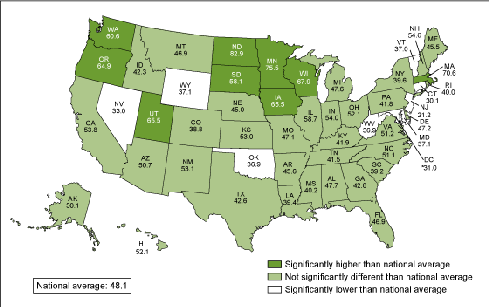
Percentage of office-based physicians with a basic EHR system,
by state: United States, 2013. (Source: CDC)
Image Source: www.informationweek.com

The trade press has made much of these findings, but the NCHS conducted its survey from February to June of last year. Since then, ONC data shows, most leading EHR vendors have had their products certified for the 2014 edition. It's not clear how many physicians have those products, but 70% of those who attested to Meaningful Use Stage 1 use vendors that have 2014-certified systems.

"I don't think that people will necessarily struggle getting to Stage 2 because a vendor didn't provide a certified product," Rosemarie Nelson, a health IT consultant in Syracuse, N.Y., told us. "But I think there's a painful path for people to get to that vendor's certified version." Some practices will have to give up the customized templates, and there will be implementation and training issues.

Even before the recent increase in 2014 edition EHR certification, physicians were acquiring more capable systems that could meet some of the MU Stage 2 criteria, the NCHS said. From 2010 to 2013, the percentage of physicians with systems that allowed them to record patient history and demographic information increased from 74% to 83%; to order prescriptions, from 57% to 83%; to send prescriptions to pharmacies electronically, from 49% to 79%; to receive warnings of drug interactions or contraindications, from 44% to 74%; to order lab tests, from 44% to 69%; to be reminded of guideline-based interventions, from 38% to 57%; and to report to immunization registries electronically, from 27% to 39%.

The NCHS survey shows wide geographical variations in EHR adoption. In 2013, the percentage of physicians using a basic EHR system ranged from 21% in New Jersey to 83% in North Dakota. The percentage of physicians with basic systems was below the national average in Connecticut, Maryland, Nevada, New Jersey, Oklahoma, Vermont, West Virginia, and Wyoming. Adoption was above the national average in Iowa, Massachusetts, Minnesota, North Dakota, Oregon, South Dakota, Utah, Washington, and Wisconsin.
Established in 1996, TSI Healthcare provides practice management and EHR solutions to its clients. Visit this website for more information on technological healthcare systems.